Security enforced by the platform, not by every developer.
Most backend platforms give you the building blocks for security and leave the implementation to you. TaruviBase enforces multi-tenancy, ABAC, row-level security, and audit logging at the infrastructure layer. The guardrails do not depend on someone remembering to apply the right check.
Security that's built in, not bolted on.
A short look at how TaruviBase enforces multi-tenant isolation, attribute-based access control, row-level security, and audit logging at the platform layer, so the guardrails never depend on a developer remembering to apply them.
Fully isolated data, users, and configuration, per customer.
No cross-tenant leakage by design. Tenant identity is a first-class concept on every row, every query, every webhook, every file, and every event, enforced at the platform layer rather than left to convention in application code.
- Per-tenant data, users, secrets, and configuration
- Tenant context attached to every authenticated request
- Tenant-aware caching and rate limits
- Hard isolation available for regulated workloads
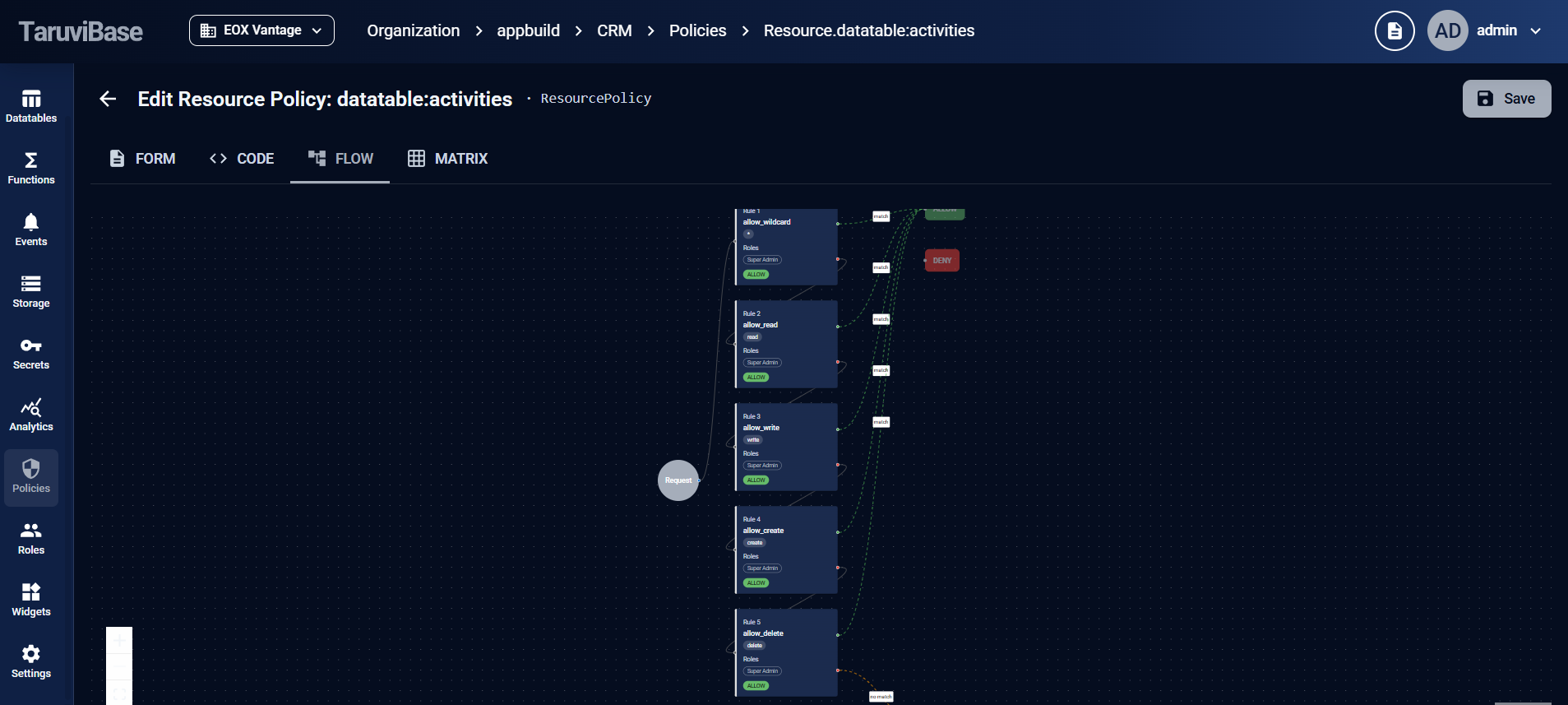
Permissions based on attributes, not just roles.
Roles describe what someone is. ABAC describes what they're allowed to do, and when. Permissions can depend on user attributes, resource properties, and environmental context, handling complex enterprise permission models that role-based systems cannot.
- User attributes: region, department, clearance, claim group
- Resource attributes: classification, owner, lifecycle stage
- Environmental: time of day, IP range, MFA status
- Decisions logged with the full attribute set
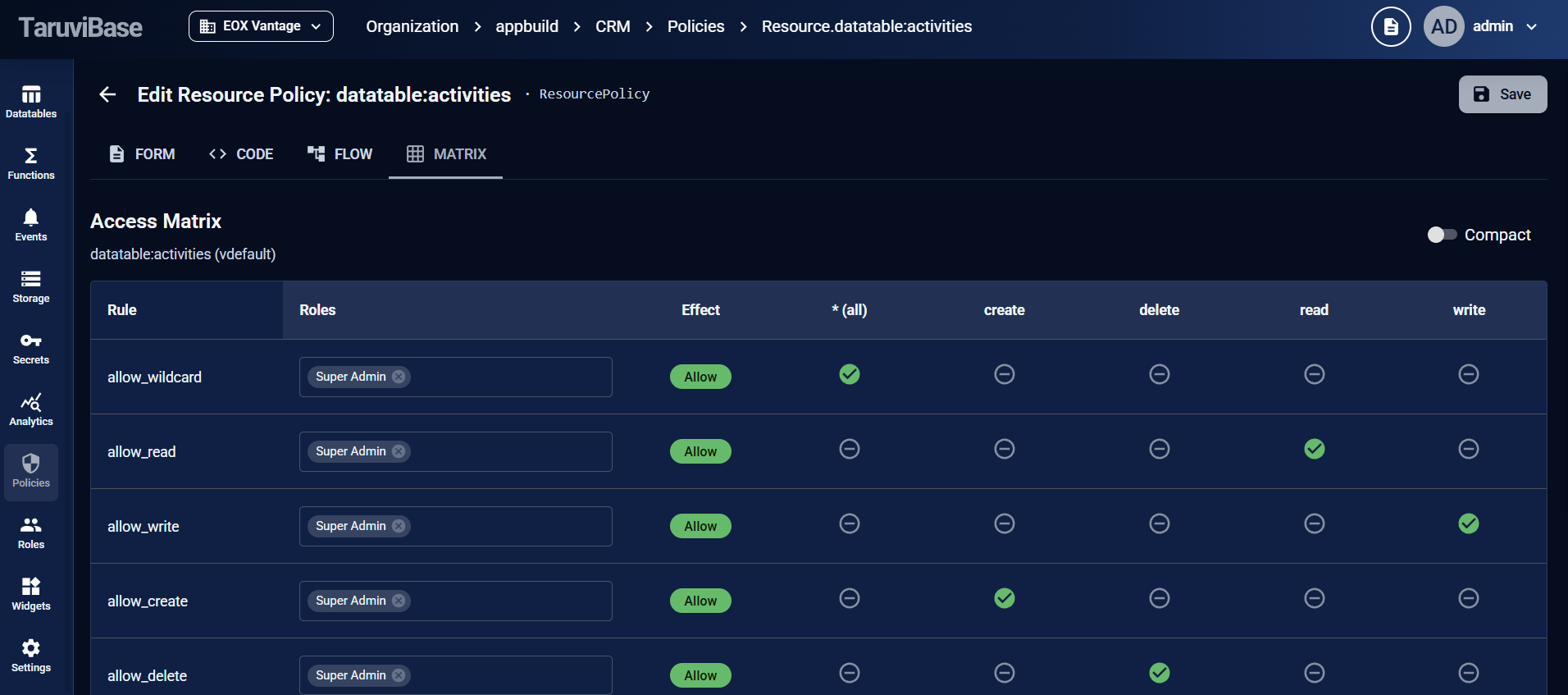
Filtering enforced at the database, not the application.
Database queries are filtered automatically based on the authenticated user. Users only see the rows they're authorized to access, and every query carries the same constraints whether it comes from your app, the auto-generated API, the MCP layer, or the analytics console.
- RLS predicates compiled from declarative policies
- Enforced at the database layer for every query path
- Same rules applied to REST, SDK, MCP, and analytics
- Predicate-aware caching so performance is not the trade-off
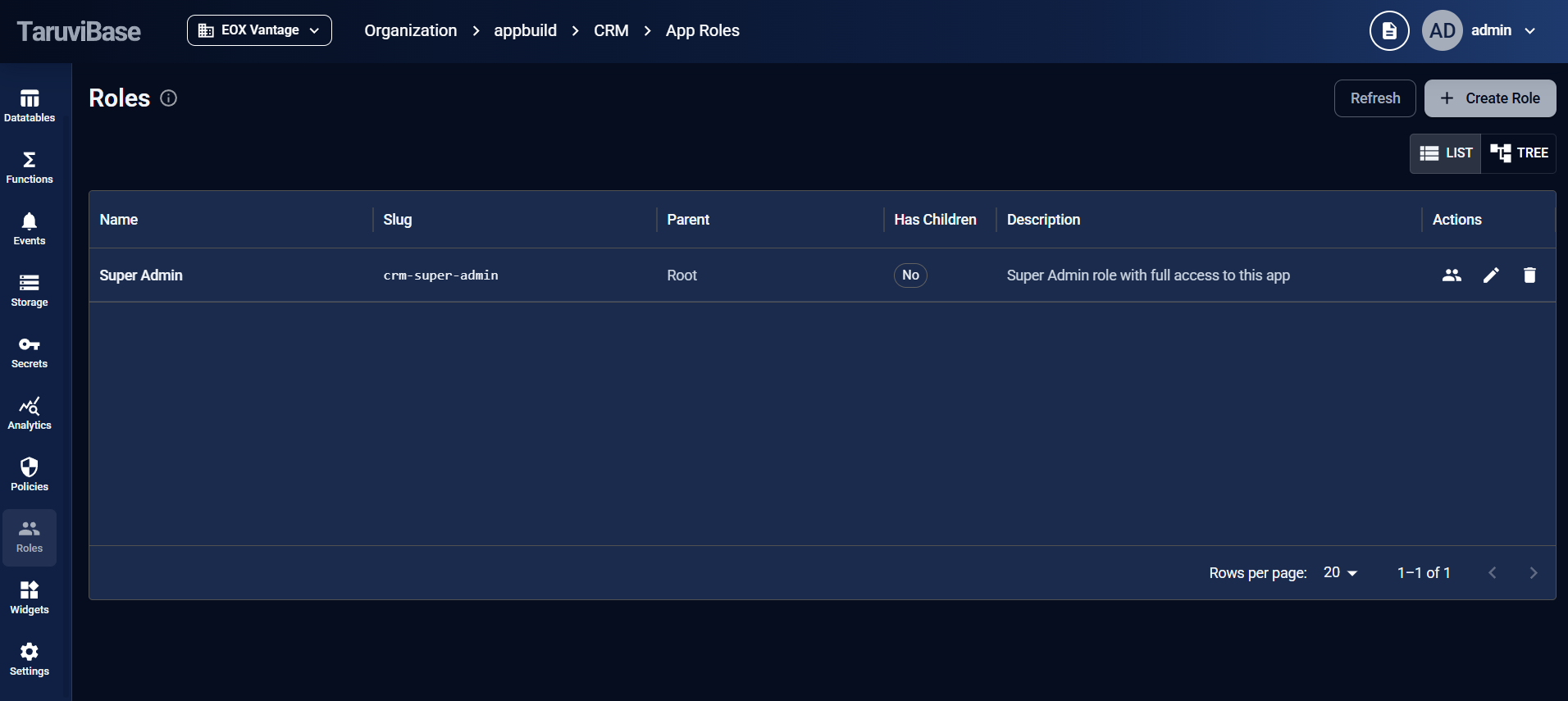
Who accessed what data, when, from day one.
Every read, write, policy decision, AI tool call, and admin action lands in an append-only audit log. No additional configuration. Everything your compliance team needs is already there, and queryable like any other data in TaruviBase.
- Append-only log, retained per your contract
- Includes denied actions, not just successful ones
- Captures full ABAC decision context
- Streamable to your SIEM via webhook
Built for insurance carriers, MGAs, and insurtechs.
For insurance teams, audit trails, data isolation, and access controls are not optional features. TaruviBase meets the compliance baseline of the most regulated environments out of the box.
Audit-ready by design
Every access logged, retained, and queryable. SOC 2 / HIPAA-friendly architecture.
In transit and at rest
TLS everywhere. AES-256 at rest. Per-tenant key options for hard-isolation customers.
Zero-trust internals
Engineer access is scoped, time-bound, and audit-logged like any other principal.
Want a security & compliance walkthrough?
Bring your security team. We'll walk through tenant isolation, ABAC policy authoring, and audit log integrations in your environment.
Frequently asked questions.
How does TaruviBase handle multi-tenant isolation and data isolation between customers?
Each customer gets fully isolated data, users, secrets, and configuration, with no cross-tenant leakage by design. Tenant identity is a first-class concept on every row, query, webhook, file, and event, enforced at the platform layer rather than left to application code. Hard isolation is available for regulated workloads.
What is attribute-based access control (ABAC) and how does TaruviBase use it?
ABAC decides what someone is allowed to do based on attributes, not just roles. Permissions can depend on user attributes like region or clearance, resource attributes like classification or lifecycle stage, and environmental context like time of day, IP range, or MFA status, so it handles complex enterprise permission models that role-based systems cannot.
How does row-level security (RLS) work in TaruviBase?
Row-level security filters database queries automatically based on the authenticated user, so users only see the rows they are authorized to access. The same predicates are compiled from declarative policies and enforced at the database layer for every query path, whether it comes from REST, the SDK, the MCP layer, or the analytics console.
What does TaruviBase audit logging capture for compliance?
Every read, write, policy decision, AI tool call, and admin action lands in an append-only audit log from day one, with no additional configuration. It includes denied actions and the full ABAC decision context, is retained per your contract, and can be streamed to your SIEM via webhook.
Is TaruviBase SOC 2 and HIPAA compliant?
TaruviBase is built on a SOC 2 / HIPAA-friendly architecture designed to meet the compliance baseline of highly regulated environments out of the box. Audit trails, data isolation, and access controls are built in, so every access is logged, retained, and queryable.
How does TaruviBase encrypt data in transit and at rest?
TaruviBase uses TLS everywhere for data in transit and AES-256 for data at rest. Per-tenant key options are available for hard-isolation customers.